What Causes Overstock in Retail (And How to Fix It)

Kshitij Kumar
Chief Data and AI Officer

Overstock isn’t a planning mistake. It’s a systems failure.
For years, retail leaders have been told that excess inventory is the result of inaccurate forecasting, poor demand planning, or slow sell-through. That’s true, but it’s also incomplete. Those are symptoms. The real causes of overstock are structural, systemic, and self-inflicted by modern retail organizations’ operations.
To understand overstock, it helps to start with its mirror image: stockouts. The same forces that create empty shelves often create overflowing warehouses, just at different points in time.
Let’s unpack this with a sharper lens.
The Real Drivers of Overstock
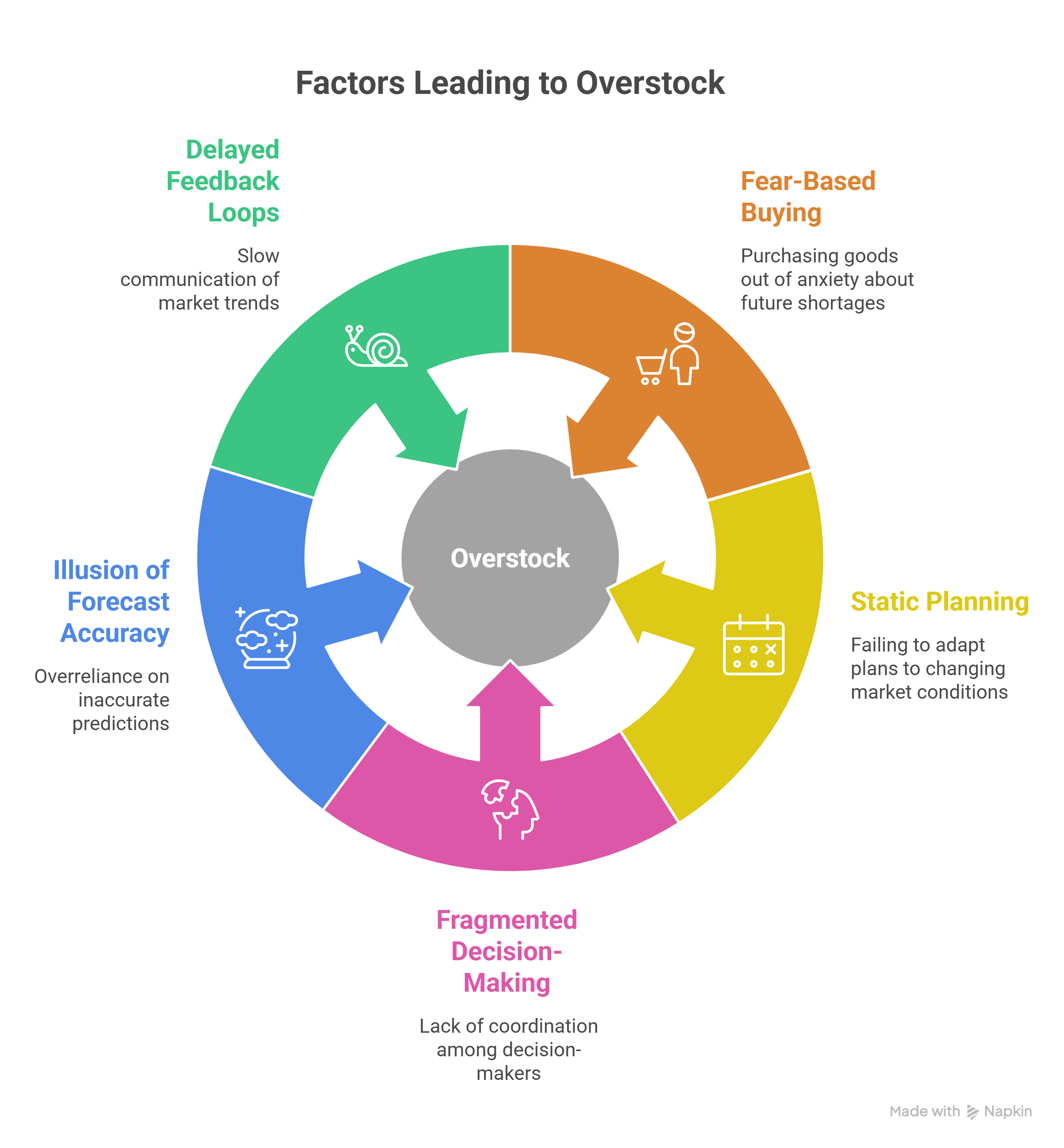
Most discussions on stockouts point to recurring themes:
- Demand volatility
- Supply chain delays
- Poor data visibility
- Siloed decision-making
- Over-reliance on historical trends
Now flip the timeline.
When retailers react to these uncertainties, they overcompensate, and that’s where overstock is born.
1. Fear-Based Buying: The Hidden Driver
Stockouts create panic. Panic drives over-ordering.
When a category misses sales due to unavailable stock, the next buying cycle becomes defensive:
- “We can’t miss again.”
- “Let’s increase depth.”
- “Let’s buy earlier.”
This leads to inventory hedging; buying more than needed to insure against uncertainty.
The Result:
You don’t eliminate stockouts. You simply convert them into overstock, delayed.
2. Static Planning in a Dynamic Market
Most retail planning cycles are still rigid:
- Seasonal buys locked months in advance
- Fixed allocation decisions
- Minimal in-season correction
But consumer demand today is fluid:
- Trends shift in weeks, not seasons
- Social media drives sudden spikes (and drops)
- Regional preferences fragment demand
The Mismatch:
Static plans + dynamic demand = inevitable excess inventory.
3. Fragmented Decision-Making
In large retail organizations:
- Merchandising decides assortment
- Planning decides quantities
- Supply chain decides replenishment
- Stores decide markdown timing
Each function optimizes for its own KPI.
The Problem:
No one owns inventory as a system.
This leads to:
- Overbuying at the top
- Misallocation in the middle
- Late markdowns at the bottom
4. The Illusion of Forecast Accuracy
Retailers invest heavily in forecasting models. But here’s the uncomfortable truth:
Forecasts don’t fail because they’re inaccurate. They fail because they’re static.
Even a “90% accurate” forecast becomes useless when:
- Demand shifts mid-season
- Weather changes buying behavior
- Competitor actions disrupt trends
The Insight:
Overstock isn’t caused by bad forecasts. It’s caused by inflexible execution after the forecast.
5. Delayed Feedback Loops
Retailers operate with lagging signals:
- Sales reports arrive late
- Replenishment decisions are periodic
- Markdown actions are reactive
By the time a product is identified as slow-moving:
- Inventory has already piled up
- Corrective action becomes expensive
The Outcome:
Retailers don’t prevent overstocking. They manage its consequences.
6. Over-Reliance on Safety Stock
Safety stock is meant to buffer uncertainty. But in many organizations, it becomes a crutch:
- High safety stock levels across categories
- Blanket policies instead of SKU × size-level intelligence
The Irony:
Safety stock designed to prevent stockouts becomes a primary cause of overstock.
Overstock Is a Timing Problem, Not a Quantity Problem
Most retailers ask:
“How much inventory should we buy?”
The better question is:
“When should inventory decisions change?”
Overstock happens when decisions are made too early and changed too late.
How to Fix Overstock (Without Just Cutting Inventory)?
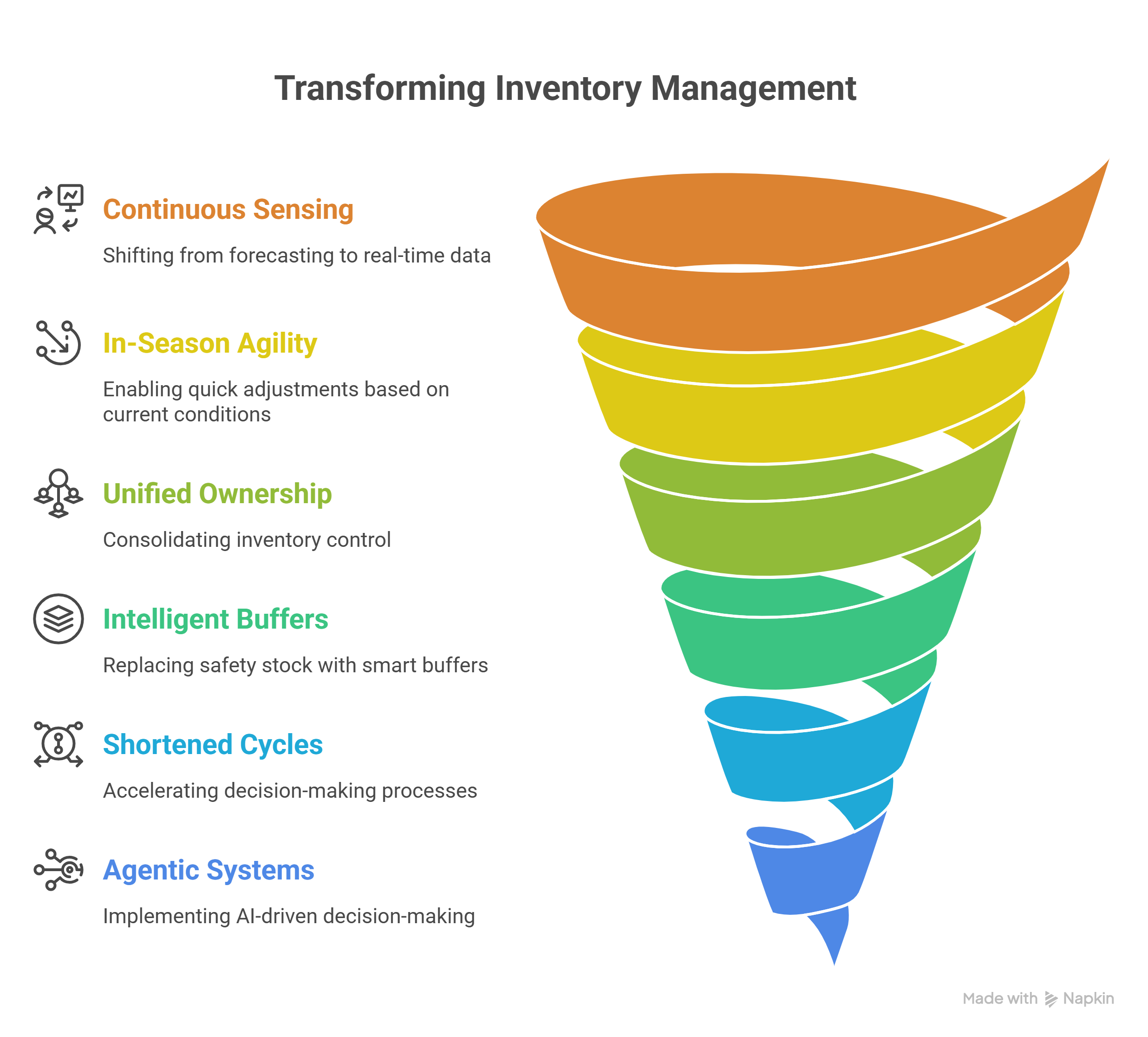
Traditional fixes focus on reducing buys or increasing markdowns. Both are blunt instruments. A smarter approach is to redesign how decisions are made.
1. Move from Forecasting to Continuous Sensing
Instead of relying on pre-season forecasts:
- Continuously update demand signals
- Integrate real-time sales, store-level data, and external trends
Shift:
From predict and commit → sense and adapt
2. Enable In-Season Decision Agility
Retailers need the ability to:
- Reallocate inventory dynamically across stores
- Adjust replenishment weekly (or daily)
- React to micro-trends regionally
Key Idea:
Inventory should flow, not sit.
3. Unify Inventory Ownership
Break functional silos by aligning teams around a single goal: maximize inventory productivity, not just sales or margins.
This means:
- Shared KPIs across merchandising, planning, and supply chain
- Centralized visibility of inventory across the network
4. Replace Safety Stock with Intelligent Buffers
Not all SKUs need the same buffer.
Use:
- SKU × Store × Size-level variability
- Lead time sensitivity
- Demand volatility
To dynamically adjust safety stock.
5. Shorten Decision Cycles
The faster you act, the less inventory accumulates.
- Daily or near-real-time monitoring
- Automated alerts for slow movers
- Early, targeted interventions
6. Introduce Agentic Decision Systems
This is where the real shift happens.
AI agents can:
- Continuously monitor inventory across stores
- Predict demand shifts in real time
- Automatically trigger reallocation, replenishment, or markdown actions
The Advantage:
They eliminate delays between signal and action.
The Bottom Line
Overstock isn’t just about excess inventory. It’s about decision latency in a fast-moving system.
Retailers that continue to:
- Plan early
- Act late
- Operate in silos
Will keep oscillating between stockouts and overstock.
Final Thought
The future of retail inventory isn’t about being more accurate; it’s about being more responsive.
Because in modern retail:
The winners aren’t those who predict demand best; they’re the ones who adapt to it fastest.
Explore how Data-Hat AI and Orkestra AI agents can shorten the gap between signal and action for your network. Contact us to discuss a pilot.
Frequently Asked Questions
How can what causes overstock in retail (and how to fix it) help retail teams?
It provides practical guidance for improving planning, forecasting, and execution decisions so teams can reduce stock risk and improve customer outcomes.
Why is AI important for modern retail operations?
AI helps retailers process large, fast-changing datasets and generate better decisions for forecasting, inventory, pricing, and assortment in real time.
How do I get started with Data-Hat AI for this use case?
Start by identifying a high-impact category or process, connect core data sources, and run a focused pilot to measure uplift in forecast accuracy, availability, and margin.