
Integrating Agentic AI with Legacy ERPs: A CTO's Roadmap for Fashion Retail Digital Transformation

Kshitij Kumar
Chief Data and AI Officer

Fashion retail is not just constrained by seasonal cycles; it is driven by continuous demand volatility, micro-trends, and omnichannel complexity. Yet most fashion enterprises still rely on legacy ERP systems designed for a slower, more predictable world.
For CTOs, the challenge is not just modernization; it is how to introduce intelligence without destabilizing core systems.
This is where Agentic AI, through platforms like Data-Hat AI and orchestration frameworks such as Orkestra AI, becomes a strategic lever.
The Reality: Your ERP Is Critical but Inflexible
As a CTO, you already know:
- Your ERP is deeply embedded across finance, supply chain, and retail operations
- It is not easily replaceable without multi-year risk exposure
- Customizations have accumulated over time, increasing fragility
Yet the business is asking for:
- Real-time inventory visibility
- Faster allocation decisions
- AI-driven forecasting and replenishment
- Reduced markdown dependency
The friction lies here: ERPs ensure control, but they limit agility.
Agentic AI: A New Architectural Layer, Not Another System
Agentic AI introduces a decisioning and execution layer that sits above your ERP stack. Unlike traditional analytics or ML models:
- It does not stop at prediction
- It continuously evaluates outcomes
- It takes autonomous or semi-autonomous action
Platforms like Data-Hat AI deploy domain-specific agents:
- Allocation agents optimizing SKU-store distribution
- Replenishment agents dynamically adjusting stock flows
- Markdown agents preserving margin integrity
- Demand agents refining forecasts in near real-time
These agents use your ERP as the execution engine, not a dependency to be replaced.
Why CTOs Should Reject "Rip-and-Replace" Narratives?
From a technology leadership perspective, replacing legacy ERP systems is rarely justified:
- High Cost: Multi-million dollar transformation programs
- High Risk: Operational disruption across stores and supply chain
- Low Differentiation: ERP replacement rarely creates competitive advantage
The correct strategy is augmentation through an intelligent layer, not replacement.
Reference Architecture: How the Stack Evolves
To integrate Agentic AI effectively, CTOs should think in terms of layered architecture:
1. ERP Layer (System of Record & Execution)
- Inventory, orders, finance
- Remains unchanged in core logic
- Handles transactional integrity
2. Data Integration Layer
- API-first or middleware-driven
- Event streaming (inventory updates, sales signals)
- Ensures near real-time data availability
Key principle: Non-invasive integration over deep customization
3. Agentic AI Layer (Decision Engine)
- Continuously processes structured and unstructured data
- Runs optimization algorithms aligned with business KPIs
- Generates executable decisions
4. Orchestration Layer (Coordination & Governance)
- Manages multiple agents simultaneously
- Resolves conflicting objectives (e.g., sell-through vs. margin)
- Aligns actions with enterprise strategy
This is where platforms like Data-Hat AI operate.
5. Execution Interface
- APIs or RPA connectors pushing decisions into ERP
- Human-in-the-loop controls for governance
- Audit trails for compliance and traceability
Implementation Roadmap for CTOs
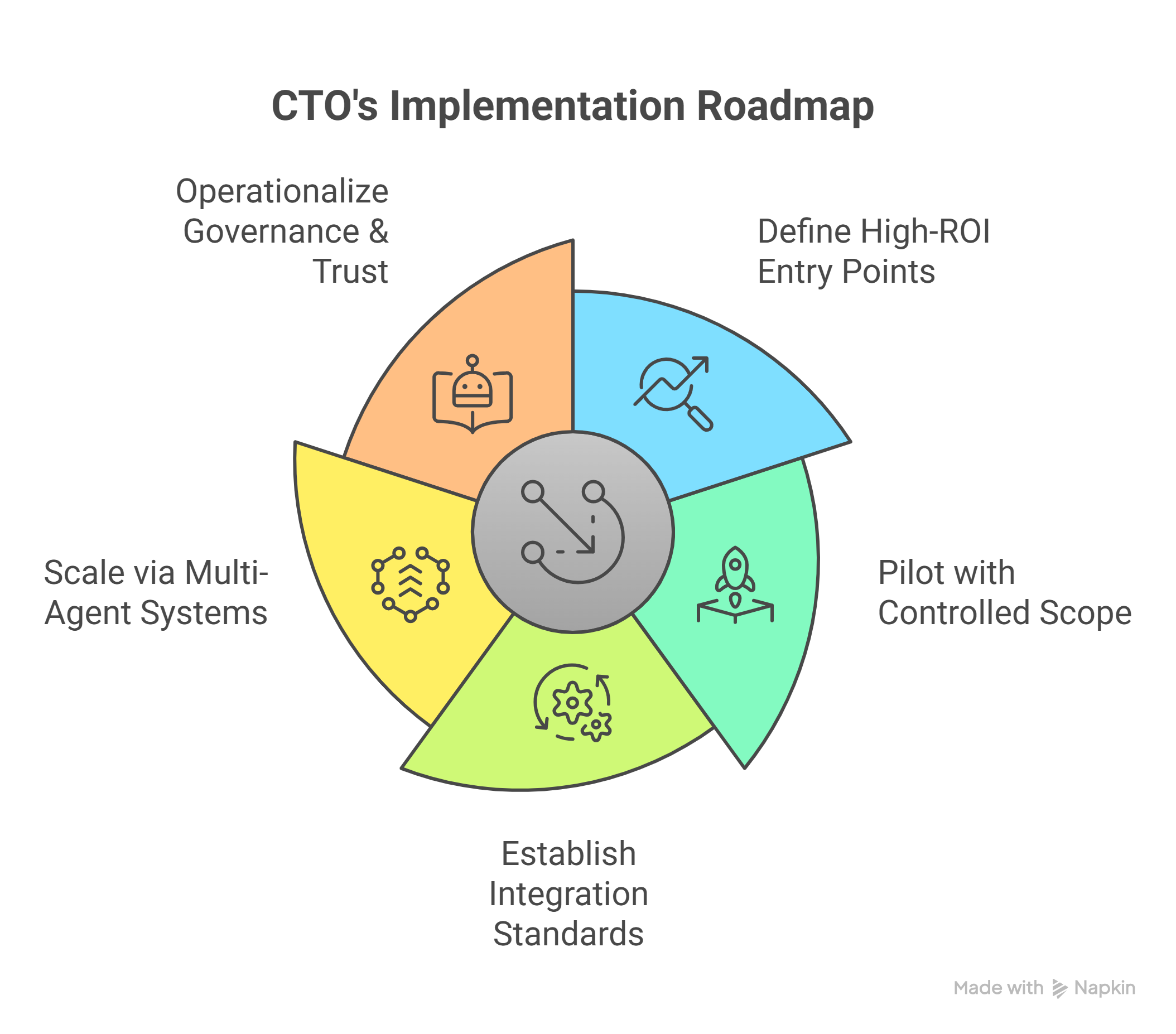
Phase 1: Define High-ROI Entry Points
Focus on areas with clear inefficiencies:
- Store-level inventory imbalance
- Overstocks leading to forced markdowns
- Slow replenishment cycles
Establish measurable KPIs:
- Inventory turns
- Full-price sell-through
- GMROI (Gross Margin Return on Investment)
Phase 2: Pilot with Controlled Scope
Deploy a single agent:
- One category (e.g., women's apparel)
- Limited geography or store cluster
Objectives:
- Validate integration approach
- Measure performance uplift
- Identify operational friction
Phase 3: Establish Integration Standards
Before scaling:
- Standardize APIs and data contracts
- Define event-driven workflows
- Ensure security and access control
Avoid one-off integrations; build reusable infrastructure.
Phase 4: Scale via Multi-Agent Systems
Introduce multiple agents across functions:
- Allocation + Replenishment
- Demand + Markdown
At this stage, orchestration becomes essential to:
- Prevent decision conflicts
- Maintain global optimization
- Align with business priorities
Phase 5: Operationalize Governance & Trust
For enterprise adoption:
- Implement explainability layers for AI decisions
- Maintain human override capabilities
- Create audit logs for compliance
CTOs must ensure trust is engineered into the system, not assumed.
Key Technical Considerations
Scalability
- Ensure horizontal scalability of agent workloads
- Handle high-frequency data updates across stores
Latency
- Near real-time decision loops require low-latency pipelines
- Batch processing is insufficient for modern retail
Data Quality
- Garbage in, garbage out still applies
- Invest in data normalization and validation pipelines
Security & Compliance
- Role-based access control
- Data encryption across layers
- Auditability for financial and operational decisions
Organizational Impact: Technology Driven Operating Model Change
The introduction of Agentic AI will reshape how teams operate.
From:
- Manual planning cycles
- Spreadsheet-driven decisions
- Reactive firefighting
To:
- Exception-based management
- AI-assisted decision supervision
- Continuous optimization
For CTOs, this means:
- Partnering closely with business leaders
- Driving change management alongside technology rollout
- Redefining success metrics beyond system uptime
Final Thought: CTOs as Architects of Intelligence
The next phase of digital transformation in fashion retail will not be defined by new systems, but by how intelligently existing systems are used.
Agentic AI, powered by platforms like Data-Hat AI, gives CTOs a pragmatic path forward:
- Preserve ERP stability
- Introduce intelligent automation
- Scale innovation without disruption
The opportunity is clear: transform your ERP from a system of record into a system of intelligent action, without replacing it.
Frequently Asked Questions
How can integrating agentic ai with legacy erps: a cto's roadmap for fashion retail digital transformation help retail teams?
It provides practical guidance for improving planning, forecasting, and execution decisions so teams can reduce stock risk and improve customer outcomes.
Why is AI important for modern retail operations?
AI helps retailers process large, fast-changing datasets and generate better decisions for forecasting, inventory, pricing, and assortment in real time.
How do I get started with Data-Hat AI for this use case?
Start by identifying a high-impact category or process, connect core data sources, and run a focused pilot to measure uplift in forecast accuracy, availability, and margin.